Detailed product reference
Summaries refer to the listed Japanese product. Eligibility, adjustments and full risks depend on its label and strength; a clinician determines individual treatment.
Product overview
Jardiance is a selective SGLT2 inhibitor; Japanese 10 mg products also have heart-failure and kidney-disease uses.
Read source section ↗Mechanism of action
Reduces renal glucose reabsorption and affects sodium/fluid handling.
Read source section ↗Japanese indications & eligibility
10/25 mg: type 2 diabetes. 10 mg: selected chronic heart failure and chronic kidney disease, excluding terminal renal failure/dialysis.
Read source section ↗Administration & dose differences
Usually 10 mg once daily before/after breakfast; diabetes may be escalated to 25 mg. Heart/kidney uses remain 10 mg.
Read source section ↗Adverse effects & key risks
Risks include volume depletion, urinary/genital infection and ketoacidosis, sometimes without marked hyperglycemia.
Read source section ↗Contraindications & special populations
Contraindications include severe ketosis/coma, serious infection, perioperative states, severe trauma and hypersensitivity.
Read source section ↗Drug interactions
Insulin/sulfonylureas increase hypoglycemia risk; diuretics may increase volume depletion.
Read source section ↗Assessment & monitoring
Monitor renal function, volume status, blood pressure, glucose and infection or ketoacidosis symptoms.
Read source section ↗Storage & handling
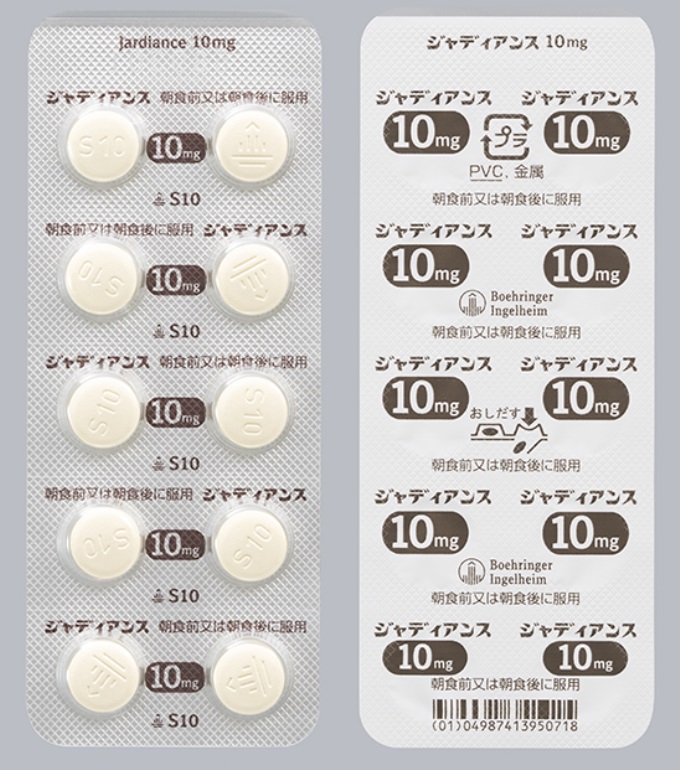
Store at room temperature. The photo is the Japanese 10 mg blister.
Read source section ↗Sources & verification
Product checked ·
- PMDA electronic package insert ↗www.pmda.go.jp
Primary source for mechanism, indications, doses and risks; revision: 2025-09.
- Manufacturer information ↗www.bij-kusuri.jp
Official product or related information; professional portals may require identity confirmation.
- Wikipedia: ingredient background ↗en.wikipedia.org
Background reference; Japanese approvals and administration are governed by PMDA sources.