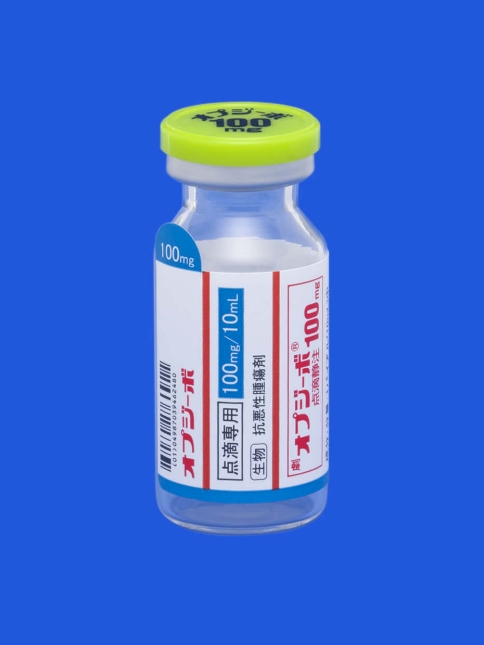
Detailed product reference
Summaries refer to the listed Japanese product. Eligibility, adjustments and full risks depend on its label and strength; a clinician determines individual treatment.
Product overview
Opdivo is an anti-PD-1 immune-checkpoint antibody. Vial strength is different from total treatment dose.
Read source section ↗Mechanism of action
Blocks PD-1 binding to PD-L1/PD-L2, restoring antitumor T-cell activity; normal organs may also be affected.
Read source section ↗Japanese indications & eligibility
Japanese labeling covers multiple selected cancers. Stage, prior therapy, biomarkers and combination requirements differ by indication.
Read source section ↗Administration & dose differences
Some adult monotherapy regimens use 240 mg every two weeks or 480 mg every four weeks; combinations and pediatric regimens differ.
Read source section ↗Adverse effects & key risks
Important risks include pneumonitis, colitis, hepatitis, endocrine disease, nephritis, myocarditis and infusion reactions.
Read source section ↗Contraindications & special populations
Ingredient hypersensitivity is contraindicated. Review autoimmune disease, transplantation, lung disease, infection and pregnancy.
Read source section ↗Drug interactions
Combination toxicity and immunosuppressive medicines require oncology review.
Read source section ↗Assessment & monitoring
Monitor blood counts, liver/kidney function, glucose, thyroid function and clinically indicated imaging.
Read source section ↗Storage & handling
Refrigerate unopened vials at 2–8°C, protect from light and do not freeze. Preparation is for clinical staff.
Read source section ↗Sources & verification
Product checked ·
- PMDA electronic package insert ↗www.pmda.go.jp
Primary source for mechanism, indications, doses and risks; revision: 2026-09.
- Manufacturer information ↗www.oncology.bmshealthcare.jp
Official product or related information; professional portals may require identity confirmation.
- Wikipedia: ingredient background ↗en.wikipedia.org
Background reference; Japanese approvals and administration are governed by PMDA sources.