Detailed product reference
Summaries refer to the listed Japanese product. Eligibility, adjustments and full risks depend on its label and strength; a clinician determines individual treatment.
Product overview
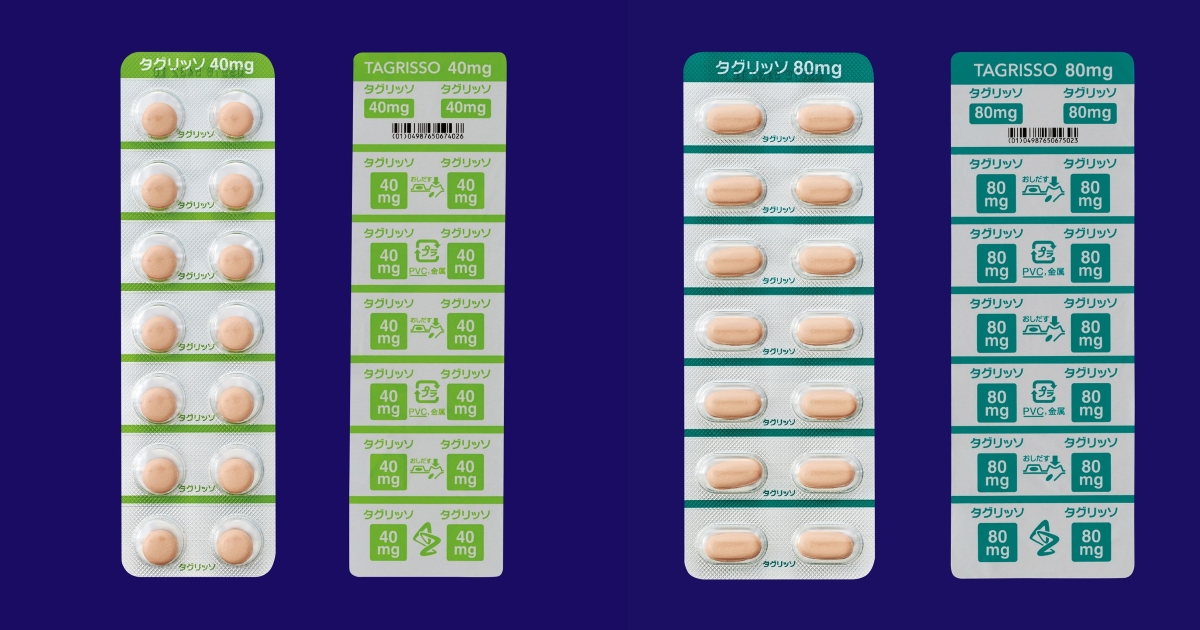
Tagrisso is a third-generation EGFR tyrosine-kinase inhibitor, supplied as 40 and 80 mg tablets.
Read source section ↗Mechanism of action
Irreversibly inhibits selected mutant EGFR signaling, including sensitizing mutations and T790M.
Read source section ↗Japanese indications & eligibility
Japanese uses include selected EGFR-positive advanced/recurrent NSCLC, postoperative adjuvant treatment and maintenance after definitive chemoradiotherapy.
Read source section ↗Administration & dose differences
Usually 80 mg once daily; clinicians may reduce or interrupt treatment. Adjuvant treatment is limited to 36 months in the label.
Read source section ↗Adverse effects & key risks
Important risks include interstitial lung disease, QT prolongation, cardiac dysfunction and blood or serious skin abnormalities.
Read source section ↗Contraindications & special populations
Contraindicated in pregnancy/possible pregnancy and ingredient hypersensitivity.
Read source section ↗Drug interactions
Review CYP3A inducers, QT-prolonging drugs and relevant transporter substrates.
Read source section ↗Assessment & monitoring
Confirm EGFR status and monitor lung symptoms, imaging, laboratory results and cardiac measures when indicated.
Read source section ↗Storage & handling
Store at room temperature in the original packaging; the photo shows 40 and 80 mg blisters.
Read source section ↗Sources & verification
Product checked ·
- PMDA electronic package insert ↗www.pmda.go.jp
Primary source for mechanism, indications, doses and risks; revision: 2026-09.
- Manufacturer information ↗www.tagrisso.jp
Official product or related information; professional portals may require identity confirmation.
- Wikipedia: ingredient background ↗en.wikipedia.org
Background reference; Japanese approvals and administration are governed by PMDA sources.