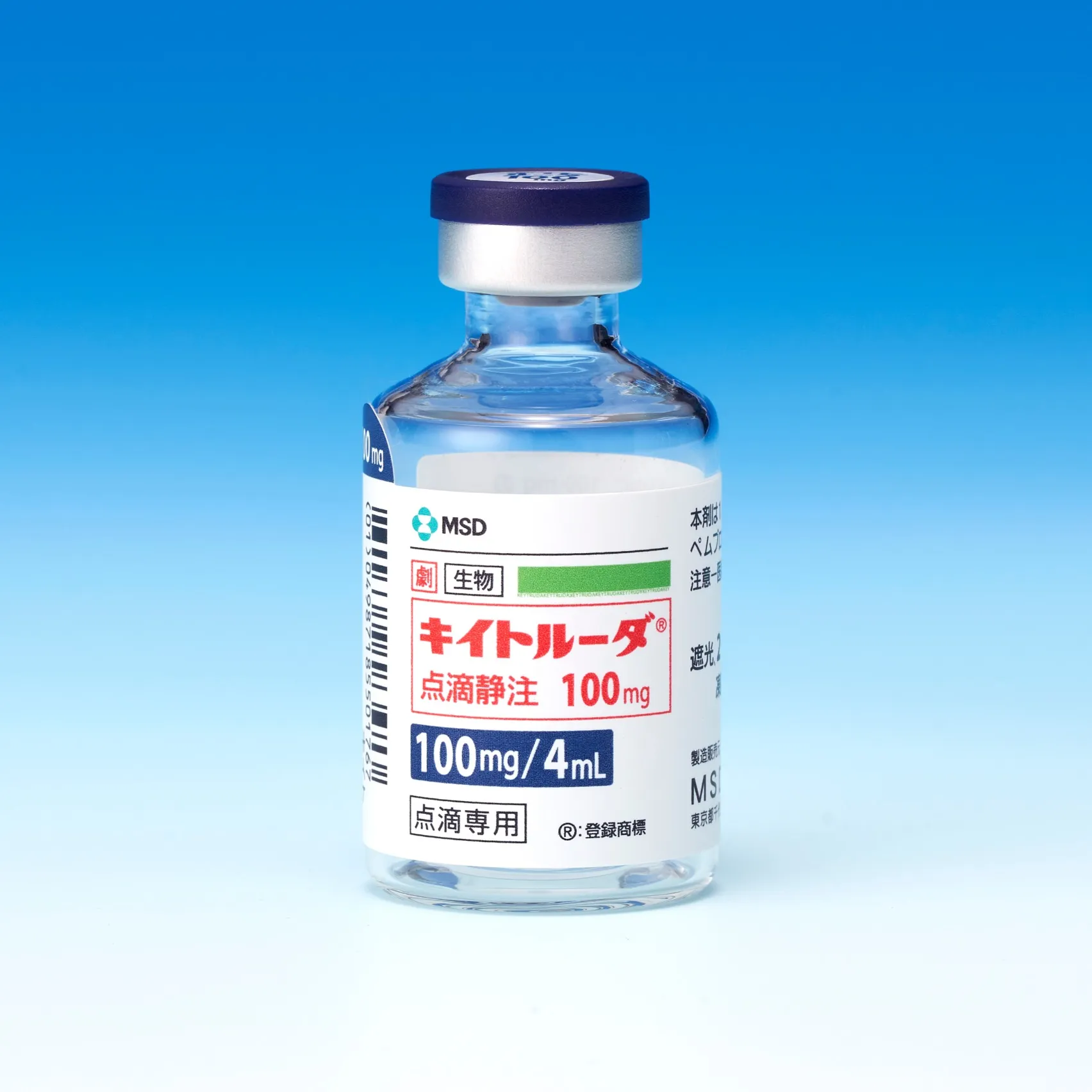
Detailed product reference
Summaries refer to the listed Japanese product. Eligibility, adjustments and full risks depend on its label and strength; a clinician determines individual treatment.
Product overview
Keytruda is a humanized anti-PD-1 antibody. This record covers the Japanese 100 mg intravenous vial.
Read source section ↗Mechanism of action
Blocks PD-1 signaling. PD-L1, MSI/MMR or TMB testing is relevant to selected indications, with different eligibility rules.
Read source section ↗Japanese indications & eligibility
Japanese indications include selected solid tumors and lymphomas, including biomarker-defined uses and some perioperative regimens.
Read source section ↗Administration & dose differences
Common adult schedules are 200 mg every three weeks or 400 mg every six weeks, infused over 30 minutes.
Read source section ↗Adverse effects & key risks
Monitor immune-related lung, bowel, liver, kidney, endocrine, cardiac and skin events, plus infusion reactions.
Read source section ↗Contraindications & special populations
Ingredient hypersensitivity is contraindicated; review autoimmune disease, transplant, infection, lung disease and pregnancy.
Read source section ↗Drug interactions
Check each combination partner and coordinate immunosuppressive therapy with the oncology team.
Read source section ↗Assessment & monitoring
Follow laboratory results, symptoms and tumor response. A qualifying biomarker does not guarantee benefit.
Read source section ↗Storage & handling
Store unopened vials at 2–8°C, protect from light and do not freeze.
Read source section ↗Sources & verification
Product checked ·
- PMDA electronic package insert ↗www.pmda.go.jp
Primary source for mechanism, indications, doses and risks; revision: 2026-09.
- Manufacturer information ↗www.msdconnect.jp
Official product or related information; professional portals may require identity confirmation.
- Wikipedia: ingredient background ↗en.wikipedia.org
Background reference; Japanese approvals and administration are governed by PMDA sources.